
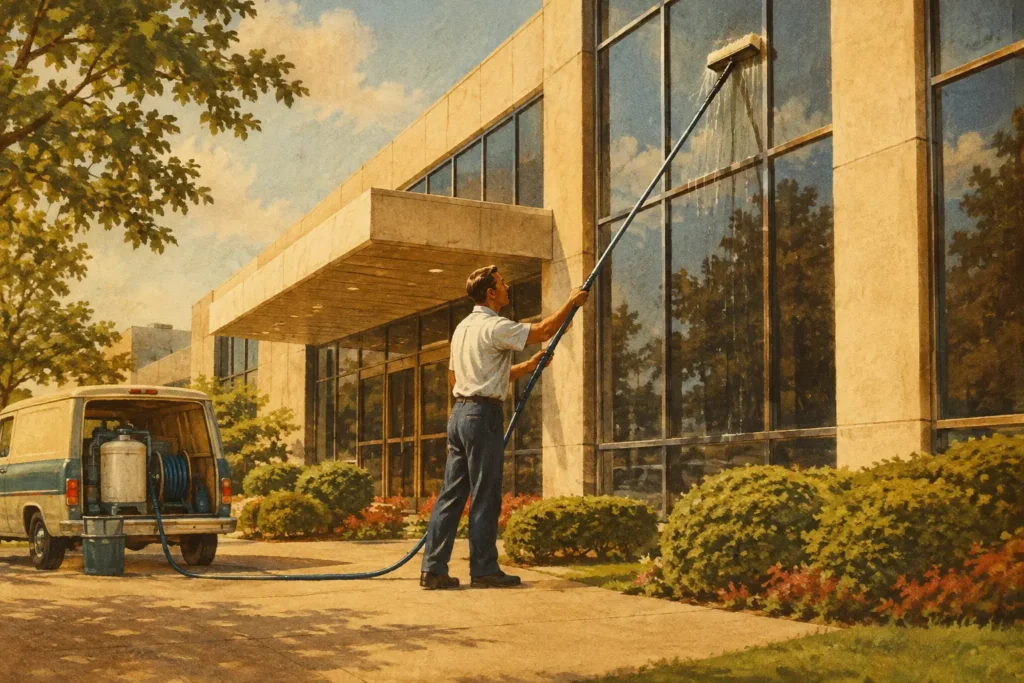
A clean office exterior sends a simple message before anyone reaches reception: this is a workplace that is looked after. This office exterior cleaning example shows what a practical, safety-focused visit can look like for a typical Buckinghamshire office, and why regular maintenance is often easier and more cost-effective than waiting for a visible problem.
The office exterior cleaning example
Picture a two-storey office building on a small business park. It has a glazed entrance, rows of first-floor windows, ground-floor meeting rooms, gutters running around the roofline and a few downpipes that discharge close to pedestrian areas. The property manager has noticed dull glass, green staining around the entrance canopy and overflowing gutters during heavy rain.
The aim is not to make the building look temporarily presentable for a single day. It is to clean the visible areas properly, identify maintenance concerns early and leave the site safe for staff, visitors and neighbouring businesses.
A professional visit would usually begin with a walk-round of the building. This helps confirm access points, parking arrangements, pedestrian routes, fragile surfaces, overhead cables, roof access limitations and any areas that need extra care. It also allows the cleaner to agree the scope with the site contact before work starts.
For this example, the agreed work includes exterior window cleaning, frames and sills, entrance doors, gutter clearing, downpipe checks and a clean of the entrance canopy. Fascias and soffits may also be included where they are accessible and need attention.
Starting with safe access and a clear plan
Office cleaning should fit around the people using the building. On a busy site, that might mean arriving before opening time, working around delivery slots or cleaning quieter elevations during office hours. Clear communication matters as much as the equipment. Staff should know where work is taking place, and public routes should be kept clear.
For upper-storey glass, a pure-water system with water-fed poles is often the right approach. The operator can clean windows from ground level instead of working from ladders, reducing risk and disruption. Purified water lifts everyday dirt from glass, frames and sills, then dries clear without leaving detergent residue behind.
That method is particularly useful for regular office window cleaning. It reaches awkward windows above landscaping, entrance areas and low roofs while keeping the operator safely on the ground. However, it is not a one-size-fits-all answer. Heavily stained glass, builders’ residue, paint splashes or old adhesive may need separate treatment, agreed in advance to avoid damage.
The entrance receives closer attention because it is where clients and staff form their first impression. Glass doors, handles, surrounding frames and lower panels collect fingerprints, road dust and rain marks quickly. Cleaning these surfaces properly improves the appearance of the whole frontage, even when the rest of the building is already well maintained.
Gutter clearance is part of protecting the building
In this office exterior cleaning example, the overflowing gutters are more than a cosmetic issue. Leaves, moss, grit and wind-blown debris can block outlets and downpipes. When water has nowhere to go, it can spill over walls, soak fascia boards, mark brickwork and create slippery patches near entrances.
A high-reach gutter vacuum allows gutters to be cleared from ground level in many situations. The work can be carried out with far less need for ladders, while camera inspection equipment can help confirm that debris has been removed. This is a sensible option for offices where roof access is limited or where the building needs to remain open throughout the visit.
Once the gutters are clear, downpipes should be checked for visible blockages and for signs that water is discharging properly. If a downpipe is damaged, disconnected or blocked below ground level, cleaning alone will not solve the issue. A reliable contractor should explain what has been found and recommend the appropriate next step rather than hiding a problem behind a quick tidy-up.
The right gutter schedule depends on the site. An office beneath mature trees may need clearance twice a year, often in late autumn and spring. A more exposed modern unit with little nearby vegetation may only need an annual inspection. Recent building work, persistent moss growth and repeated overflow all justify more frequent checks.
Dealing with green growth without harming surfaces
Green algae around entrance canopies, cladding edges, paving and shaded walls can make an office look neglected. It can also make paths slippery when wet. The answer is not always high-pressure washing.
Soft-wash methods use an appropriate cleaning solution at low pressure to treat organic growth without forcing water into joints, seals or delicate surfaces. This can be a better choice for painted finishes, rendered walls, fascias and certain roof surfaces. The surface, its condition and the surrounding drainage all need assessing first.
Pressure washing may be suitable for durable paving or hardstanding, but it needs careful control. Excessive pressure can damage pointing, strip coatings and leave visible cleaning marks. On a commercial site, the cleaner should also consider where wash water is going, protect nearby planting and avoid creating hazards for people walking through the area.
What the property manager receives after the visit
A good exterior cleaning job does not end when the equipment is packed away. The site contact should know what was completed, what condition the property was left in and whether anything needs attention.
For a straightforward office visit, this may include before-and-after photographs of difficult-to-see gutters, confirmation that windows and entrance areas have been cleaned, and notes on any defects spotted during the work. Examples might include loose gutter brackets, cracked seals, damaged downpipes, inaccessible windows or moss that may require separate roof treatment.
This record is useful for property managers, particularly where they report to a landlord or manage several sites. It gives them evidence that routine maintenance has been completed and helps them budget for repairs before minor issues become larger ones.
Why a maintenance plan is usually better than one-off cleaning
A one-off clean is useful before a tenant move-in, office reopening, inspection or client event. It can quickly improve the look of a tired frontage. But offices are exposed to traffic film, weather, bird mess, leaf fall and seasonal growth all year round.
A recurring plan keeps standards consistent without the site manager having to remember every task. Windows might be cleaned every four or eight weeks, depending on the building’s location and the level of footfall. Gutters may be cleared once or twice a year, while canopy, fascia or cladding cleans can be scheduled when needed.
There is a trade-off. More frequent visits have an ongoing cost, but they generally take less time per clean and prevent heavy build-up. For customer-facing offices, clinics, schools and retail-adjacent premises, regular cleaning also avoids the cycle of letting surfaces deteriorate and then paying for a larger restorative job.
Choosing the right contractor for the job
The cheapest quote is not always the best value if it leaves out important areas, relies on unsafe access or offers no proof of insurance. For an occupied office, look for a contractor who explains their method clearly, carries appropriate insurance and is willing to work around the needs of the site.
Ask what is included in the window clean, whether frames and sills are covered, how gutters will be inspected, and what happens if a problem is found. It is also worth confirming whether the team can provide scheduled visits and keep a record of completed work. DBS-checked operatives can offer added reassurance where staff, pupils or vulnerable visitors are present.
Spotless Cleans works with offices and commercial premises across Aylesbury and Buckinghamshire using safe-access equipment, pure-water window cleaning and high-reach gutter clearance where appropriate. The focus is straightforward: dependable service, clear communication and a clean exterior that does its job without causing hassle on site.
A well-kept office does not need constant attention, but it does need a plan. Arrange cleaning before gutters overflow, glass becomes permanently marked or a slippery green path becomes a safety concern, and the building will stay easier to manage throughout the year.