
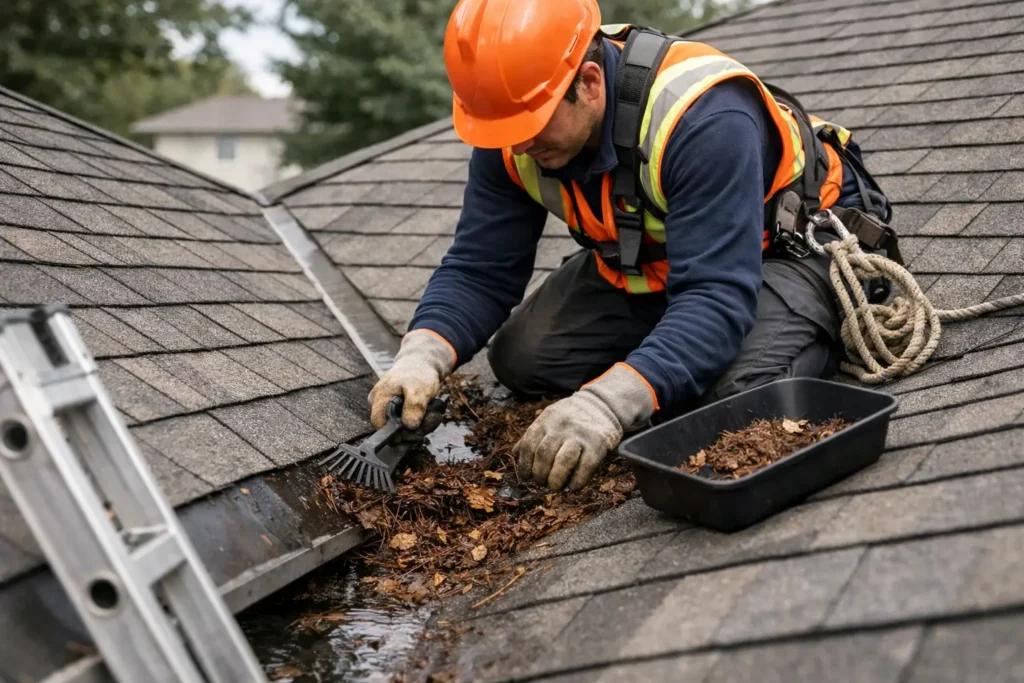
A roof valley can look like a small detail from ground level, but it is one of the busiest drainage channels on your roof. Where two roof slopes meet, rainwater is concentrated into a narrow run before reaching the gutter. Knowing how to clear roof valleys properly helps prevent water backing up beneath tiles, overflowing gutters and damp problems around the roofline.
The key is not simply removing what you can see. Leaves, moss, silt and small twigs often build up under the surface layer, particularly beneath overhanging trees or after windy weather. Clearing that material safely, without disturbing tiles or walking on a fragile roof, is what protects the property.
Why clear roof valleys need attention
A clear valley directs a large volume of water away quickly. A blocked one does the opposite: water pools behind debris, spills sideways under tiles and may find its way into the roof space. The damage is not always obvious straight away. You may first notice staining on a ceiling, damp insulation, a dripping gutter or a patch of moss that seems to keep returning.
Valleys can also feed directly into a gutter junction. If the valley and the gutter outlet are both restricted, heavy rain has nowhere to go. This is when water often overshoots the gutter, runs down fascias and soffits, or tracks onto walls below.
In Buckinghamshire, autumn leaf fall and wet winters make regular checks worthwhile. Properties near mature trees usually need more frequent attention than open sites, while roofs with active moss growth can shed debris throughout the year.
Check the valley from the ground first
Before considering any hands-on work, inspect the roof from a safe position at ground level. Binoculars can help, but you should still be able to identify obvious piles of leaves, moss clumps, branches or a visibly slow-draining section after rain.
Look for debris gathered at the lower end of the valley where it meets the gutter. Also check whether the gutter beneath is bowing, overflowing or showing plant growth. These are common signs that the blockage is affecting more than one part of the drainage system.
Do not rely on a dry day alone. A valley may look reasonably clear in sunshine but reveal its problem during rain, when water runs around rather than through a compacted layer of moss and silt. If it is safe to observe from inside or beneath a covered area, note whether water is flowing cleanly into the gutter during a shower.
Decide whether the job is safe to do yourself
The most important part of clearing a roof valley is safe access. Many homeowners can clear low-level gutters from the ground using suitable equipment, but roof valleys are different. Reaching over from a ladder is rarely stable or effective, and climbing onto tiles can crack them, dislodge them or cause a serious fall.
Avoid DIY roof access if the roof is steep, wet, mossy, high, fragile, difficult to reach or close to overhead cables. You should also leave the work to a professional if you cannot see the full valley clearly, the debris is compacted, or there are signs of loose tiles, damaged flashing or water entering the property.
A professional exterior cleaning team will assess the access before starting. Depending on the building, that may mean using appropriate ladder safety equipment, roof access equipment, high-reach vacuum systems or another controlled method. The aim is to clear the channel without damaging the roof or putting anyone at unnecessary risk.
How to clear roof valleys without causing damage
If you have safe, professional-grade access and are confident the roof covering is sound, work gently and methodically. Do not use forceful scraping, stiff metal tools or pressure washing in a valley. These methods can damage the valley lining, lift tiles, drive water under the roof covering and strip protective surface material from tiles.
The practical process is straightforward:
- Remove loose leaves, twigs and surface moss by hand or with a soft, suitable tool, working from the top down so debris does not build up further along the channel.
- Clear the lower valley outlet and the section of gutter directly beneath it. Material removed from the valley will otherwise block the gutter at the first rainfall.
- Lift out compacted debris in small amounts rather than pulling at it aggressively. If moss is rooted under tile edges or against flashing, stop and arrange an inspection.
- Check that rainwater has an open route through the valley, gutter outlet, downpipe and drain. A clear valley will not solve a blocked downpipe.
Keep all tools away from the edges of lead, zinc or other valley linings. These linings can be dented or punctured, and their joints may be vulnerable on older roofs. If you find a split lining, exposed underlay, slipped tile or crumbling mortar, cleaning alone is not the answer. The defect needs appropriate roofing attention before the next period of heavy rain.
Do not wash debris into the gutter
A garden hose can appear to be a quick way to test flow, but it often creates a second blockage further down. Loose moss and silt may wash into the gutter outlet, settle in a bend of the downpipe, or collect at the drain below. High-pressure equipment is an even bigger risk, especially if water is directed upwards beneath tiles.
If water testing is needed, use a gentle, controlled flow only after loose material has been removed and the gutter system has been checked. Watch where the water exits. It should pass freely into the downpipe rather than pooling in the gutter or spilling over the front edge.
For properties with rainwater harvesting, take extra care to keep heavy debris out of the system. Decaying moss and leaf matter can contaminate filters and reduce the performance of water butts or collection tanks.
Moss removal is not the same as valley clearance
Clearing a blocked valley deals with the immediate drainage problem. It does not necessarily address the reason it blocked. Moss on the surrounding roof can retain moisture and gradually shed into the valley, particularly after frost, wind or heavy rain.
There is a balance to strike. Pulling thick moss from a roof without care can disturb tiles and reveal weak areas. A safer approach is to remove loose growth where appropriate, then use a suitable soft-wash treatment to slow regrowth. This should be done with the roof material, its age and the surrounding gutters in mind.
For that reason, valley clearance is often most effective as part of a broader roof and gutter maintenance visit. The roof channel is cleared, gutters and downpipes are checked, and any recurring source of debris is identified. It is more useful than repeatedly dealing with the same blockage at the lower end of the roof.
How often should roof valleys be cleared?
There is no single schedule for every property. A newer home in an open location may only need a visual check twice a year and a clean when required. A house beneath trees, or one with moss-covered roof slopes, may benefit from an inspection in late autumn and again after winter.
As a practical minimum, check roof valleys after major storms, prolonged leaf fall and any work that may have left debris on the roof, such as tree pruning or repairs. Landlords and property managers should include valleys in planned exterior maintenance, particularly on blocks, offices, schools and older buildings where drainage issues can affect several internal areas.
Regular professional gutter cleaning is also a useful early warning system. When gutters are cleared, the technician can often spot whether an unusually large amount of moss, mortar or leaf debris is coming from the valley above.
Signs you should call a professional
Arrange professional help promptly if you see water entering the loft, persistent overflow at one gutter section, loose tiles around the valley, sagging gutters, damaged flashing or vegetation growing from the roofline. These signs suggest a blockage may already be causing a wider issue.
It is also sensible to call in a trained, insured team when the valley is beyond safe reach. The cost of a professional clean is usually modest compared with repairing water-damaged plaster, insulation, timbers or roof coverings. Spotless Cleans provides safety-focused roof, gutter and moss cleaning for homes and commercial properties, using suitable modern equipment to reduce risk and protect the building.
A clear roof valley should be almost unremarkable: rain runs through it quickly, the gutter takes the flow and the roofline stays dry. A quick check before the next wet spell can be one of the simplest ways to keep it that way.