
Blocked gutters rarely announce themselves until the weather turns. By then, overflowing water may be running down brickwork, soaking fascia boards or pooling around entrances. When weighing up gutter vacuum vs ladder cleaning, the right choice is not simply about which method looks more thorough. It is about safe access, the type of debris in the gutter, the condition of the property and whether the downpipes are flowing properly.
For most homes and commercial premises, a professional gutter clean should remove the build-up without creating unnecessary risk or damage. Both methods have a place, but they are not identical services.
Gutter vacuum vs ladder cleaning: the main difference
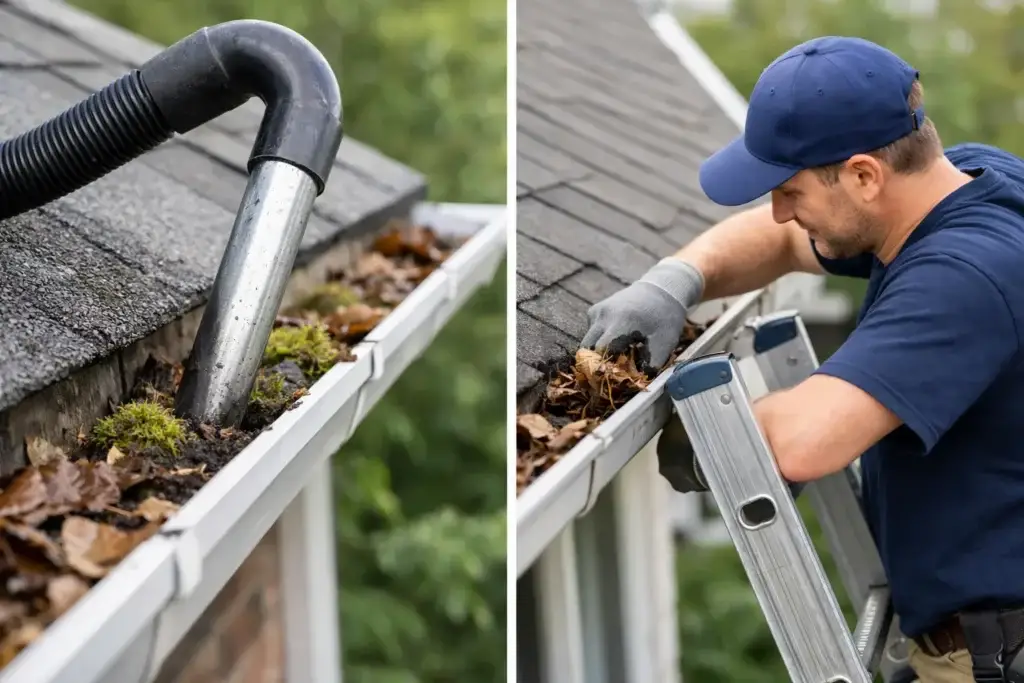
A gutter vacuum uses a powerful wet-and-dry vacuum connected to lightweight carbon-fibre poles. From ground level, an operative can reach gutters several storeys high and lift out leaves, moss, soil, standing debris and general silt. The work is normally monitored with a camera, allowing the operator to check that sections have been cleared.
Ladder cleaning involves safely accessing the gutter line by ladder, then removing debris by hand or with hand tools. This gives direct access to the gutter channel and can be useful where there is compacted material, a small obstruction or a repair issue that needs a closer look.
The difference matters because access itself carries risk. Ladders are sometimes necessary, but they are not automatically the best option for every job. A high-reach vacuum allows many gutters to be cleared from the ground, reducing working-at-height risks and avoiding the need to rest a ladder against vulnerable gutters, tiles or cladding.
Why gutter vacuum cleaning suits many properties
For routine maintenance, gutter vacuuming is often the practical choice. It is particularly useful for detached homes, properties with conservatories, commercial units and buildings where reaching the gutter by ladder would be awkward or disruptive.
The key benefit is safer access. Working from ground level reduces the chance of a fall and means there is less movement around roof edges. It also helps protect landscaped areas, fragile surfaces and narrow side passages where placing and moving a ladder can be difficult.
A professional high-reach system can also reach awkward sections over extensions, garages and conservatory roofs. Rather than climbing onto a roof or leaning over glass, the operator can clear the gutter from a controlled position below. This is a major advantage on properties where access is limited.
Speed is another consideration. A gutter vacuum can clear long runs efficiently, especially where the debris is mostly leaves, moss and loose organic matter. For landlords, managing agents and commercial site operators, this can make planned maintenance more straightforward, with less interruption around the building.
Camera inspection adds useful reassurance. It allows the operative to see what is inside the gutter before, during and after cleaning. That does not replace a full roof survey, but it provides visible evidence that the channel has been cleared and can highlight obvious issues such as sagging sections, heavy moss accumulation or a blocked outlet.
Where vacuum cleaning has limits
A vacuum is powerful, but it is not a cure for every gutter problem. Dense, compacted soil can sometimes need to be loosened manually. Large items such as tennis balls, broken tile pieces or old gutter guards may also need direct removal.
The system cleans the gutter channel, not the roof. If a roof is shedding heavy moss, the gutters may block again quickly unless the underlying roof growth is addressed with an appropriate soft-wash or moss removal plan. Similarly, vacuuming cannot repair loose brackets, cracked joints or poorly aligned downpipes.
When ladder cleaning is the better option
Ladder access can be the right call when a gutter needs close, hands-on attention. If debris has been packed tightly into an outlet, if a downpipe needs checking at the top, or if a small repair is clearly required, direct access may give a better result.
It can also help when gutter guards or unusual profiles make vacuum access less effective. Some older properties have narrow, deep or heavily obstructed gutters that need a physical inspection. In these cases, a trained, insured professional can assess whether ladder work is appropriate and use safe working methods rather than forcing a vacuum tool into an unsuitable area.
There is a practical visibility benefit too. Being at gutter level makes it easier to spot worn seals, detached end caps, vegetation growing from joints or sections pulling away from the fascia. Cleaning alone will not fix these faults, but identifying them early can prevent a minor issue becoming a leak or water-damage problem.
That said, ladder cleaning is not automatically more thorough simply because someone is closer to the gutter. Good results depend on careful removal of debris, checking the outlets and making sure water can travel freely through the downpipes. It also depends on whether the access can be carried out safely without risking the operative, the property or people nearby.
Safety should decide the access method
For homeowners, it can be tempting to treat gutter cleaning as a quick weekend task. The problem is that gutters are often above uneven ground, patios, flower beds, driveways and extensions. Wet leaves, poor footing and a ladder at the wrong angle create a real risk of injury.
Professional cleaning should begin with an assessment of the property. The operative needs to consider ground conditions, gutter height, roof layout, overhead cables, public access and any obstructions. On a shopfront, school or office site, timing and pedestrian safety matter just as much as the cleaning method itself.
Ground-based vacuum cleaning reduces many of these risks, which is why it is well suited to regular maintenance. When ladder access is needed, it should be used selectively and competently, with the right equipment and insurance in place. The aim is not to avoid ladders at all costs. It is to use the safest effective method for the job.
What about downpipes and gutter condition?
A clean-looking gutter is only useful if the water has somewhere to go. Downpipes can block with leaf matter, moss, grit and compacted sludge, particularly where the gutter outlet is poorly maintained. During a professional visit, the outlets and downpipes should be considered as part of the wider drainage path.
If water is overflowing from one spot, the cause is not always a full gutter. It may be a blocked downpipe, a joint that has come apart, a gutter section with the wrong fall, or debris collecting behind a guard. A sensible service focuses on finding the cause rather than simply removing what is visible from below.
It is also worth remembering that cleaning exposes condition issues. Once leaves and moss are removed, cracks, rust, loose brackets and tired seals may become more obvious. That is useful information. Regular cleaning gives property owners a chance to deal with small defects before repeated overflow damages paintwork, timber fascias or masonry.
Which option offers better value?
Value is about more than the initial price. A cheaper clean is poor value if it misses the difficult sections, damages a gutter, leaves an outlet blocked or requires an unsafe shortcut. Equally, there is no need to insist on ladder access where a high-reach vacuum can do the work safely and effectively from the ground.
For most routine cleans, gutter vacuuming offers an efficient balance of reach, safety and visible results. It is especially effective for properties with high gutters, limited access or conservatories below the roofline. Ladder cleaning is more likely to be worthwhile when there is a known obstruction, an access-specific issue or a need for close inspection.
The best approach is often a combination. A professional may use the vacuum for the majority of the gutter run, then use safe direct access only where it genuinely adds value. This avoids treating every property as though it has the same layout or the same level of blockage.
A sensible maintenance plan for Buckinghamshire properties
In leafy parts of Aylesbury and Buckinghamshire, gutters can fill quickly in autumn and continue collecting moss and windblown debris through the year. Properties beneath mature trees may need cleaning twice yearly, while more open homes may be fine with an annual inspection and clean. Commercial premises can benefit from scheduled visits that fit around trading hours, term times or site access requirements.
Spotless Cleans uses high-reach gutter vacuum equipment where it is the safest and most suitable option, backed by practical inspection and straightforward advice. The focus is on clearing gutters properly, reducing avoidable risk and helping customers stay ahead of water-related maintenance issues.
If your gutters are overflowing, do not wait for the next heavy shower to test them. A timely inspection can establish whether a ground-based vacuum clean is enough or whether hands-on ladder access is genuinely needed, giving you a clear route to a clean, free-flowing system.