
A gutter can look perfectly harmless from ground level, right up until water starts spilling over the edge during heavy rain. That overflow can soak brickwork, stain render, damage fascias and leave water pooling where it should not. When weighing up gutter guards versus regular clearing, the right answer is rarely a simple yes or no. It depends on the trees around the property, the roof type, the condition of the guttering and how much ongoing maintenance you are prepared to arrange.
For many homes and commercial premises, clean, free-flowing gutters are the priority. Guards can help in the right setting, but they are not a fit-and-forget replacement for professional cleaning.
What regular gutter clearing involves
Regular gutter clearing means removing leaves, moss, silt, twigs and other debris from the gutters and checking that downpipes are running freely. A proper visit should also identify obvious issues such as loose brackets, standing water, broken joints or vegetation growing from the gutter line.
In Buckinghamshire, gutters often collect more than autumn leaves. Moss from tiled roofs, small seeds, roof grit and debris carried by wind can build up gradually throughout the year. Even a property with few nearby trees can develop a blockage, particularly at the outlet to a downpipe.
Professional clearing is usually carried out using safe-access equipment. High-reach gutter vacuum systems allow trained operatives to clear many gutters from ground level, reducing the need for ladders and helping protect the property. This is especially useful for taller homes, offices, shopfronts and awkward access areas.
The main benefit is straightforward: the whole gutter channel is cleared, not just covered over. Water has a clear route to the downpipe, and potential maintenance concerns can be spotted before they turn into a larger repair job.
How gutter guards work
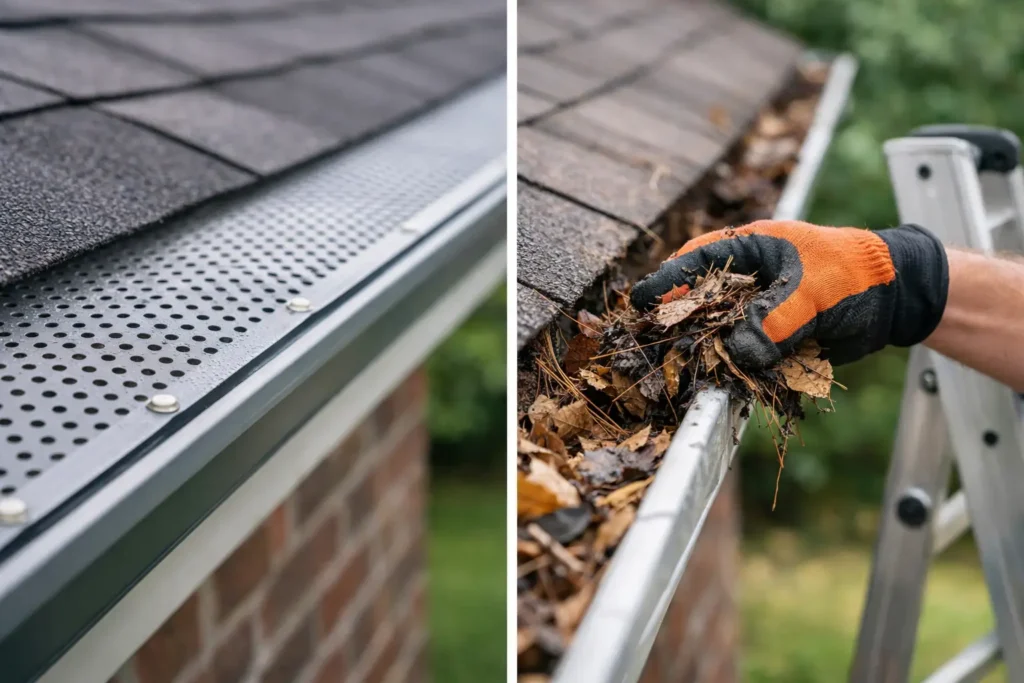
Gutter guards are covers, screens, brushes or mesh inserts designed to keep larger debris out of the gutter while allowing rainwater through. They come in several styles, from basic plastic mesh to fitted systems designed for a particular gutter profile.
Their purpose is sensible. If large leaves are constantly landing in an open gutter, a guard can reduce the volume of material getting inside. On a property surrounded by mature trees, that may mean less frequent heavy clearing.
However, a gutter guard does not stop all debris. Fine particles, roof moss, pine needles, seeds and wet leaf fragments can still settle on top of the guard or pass through it. Over time, this material can form a dense layer that slows water entry. In some cases, rain runs over the blocked surface rather than into the gutter, producing the same overflow problem the guard was meant to prevent.
Guards also need to be fitted correctly. Poorly secured mesh can lift in strong winds, catch debris or interfere with the roof edge. A system that makes it difficult to inspect the gutter may turn a small blockage into a hidden problem.
Gutter guards versus regular clearing: the key differences
The biggest difference is not whether maintenance is needed. It is where the maintenance happens.
With open gutters, debris collects inside the channel and is removed during a scheduled clear. With guards, debris may collect on the surface, inside the guard or beneath it, depending on the design and the material falling from nearby trees. Either way, an inspection and clean are still needed.
Regular clearing offers certainty. The gutter and downpipe can be checked directly, and the debris is removed rather than left to build up. It is often the more practical choice for properties with roof moss, because moss breaks down into small pieces that can pass through many guard types.
Gutter guards can reduce the amount of bulky debris entering the gutter. They may be worthwhile where there are broad leaves, accessible gutter runs and a suitable guard design. They are less convincing where fine debris is common, rooflines are complex, or gutters already have poor falls, leaking joints or undersized downpipes.
Cost is another consideration. Guards involve an upfront supply and fitting cost, followed by periodic cleaning and possible replacement. Regular clearing has no installation cost and can be arranged as a one-off service or on a maintenance schedule. For many homeowners, a planned clear once or twice a year is simpler and easier to budget for.
When gutter guards can be a sensible option
Gutter guards can be useful when they solve a specific, recurring issue rather than being added as a general precaution. A house directly beneath deciduous trees may benefit if large leaves repeatedly fill a simple, accessible gutter run. They can also help where a property owner wants to reduce the frequency of debris entering a difficult-to-reach section.
Before fitting anything, the existing guttering should be clean, sound and correctly aligned. Installing guards over a gutter already holding moss or silt only conceals the problem. Downpipes should also be tested, as a clear-looking gutter is of little use if water cannot leave it.
The chosen system matters too. Guards should suit the roof covering and gutter shape, allow water to enter freely and remain secure in poor weather. The cheapest option is not always the best value if it clogs quickly or makes future cleaning more difficult.
When regular clearing is usually the better choice
Regular clearing is often the better route for properties with mossy roofs, conifers, overhanging branches or older guttering. Fine debris is the weakness of many guard systems, and these conditions produce plenty of it.
It is also a sensible choice for landlords and commercial property managers who need clear records of maintenance. A scheduled service provides an opportunity to check gutter runs, outlets and visible roof-edge components. That is useful for reducing avoidable water damage and planning repairs before wet weather exposes them.
For schools, offices, retail units and industrial premises, the practical question is usually reliability. A maintenance plan can be timed around the seasons and the site’s access requirements, without relying on a guard to perform perfectly in every storm.
Regular clearing is not about waiting for a blockage. It works best as preventative maintenance. If water is already overflowing, staining walls or dripping from joints, the gutter should be checked promptly rather than left until the next planned visit.
Do gutter guards mean you never need gutter cleaning?
No. This is the most common misunderstanding. Gutter guards can reduce some debris, but they still require inspection and cleaning. Leaves and moss can sit on top, fine particles can settle below, and outlets can block even when the rest of the run looks clear.
A guarded gutter may need less frequent clearing in favourable conditions, but it should not be ignored. The correct interval varies. A sheltered home with little tree cover may only need an annual inspection, while a property beneath mature trees may need attention in spring and autumn, or more often after prolonged windy weather.
Choosing a maintenance plan for your property
Start by looking at what actually reaches the gutter. Large leaves, pine needles, roof moss and nearby branches each create different maintenance demands. Also consider access. Cleaning a low bungalow gutter is very different from dealing with a tall rear elevation above a conservatory or a busy commercial entrance.
A practical approach is to have the gutters professionally cleared and assessed first. Once they are clean, it is easier to see whether guards would address a genuine issue or simply add another surface that needs cleaning. This also gives you a baseline for how quickly debris returns.
For many properties in Aylesbury and the surrounding villages, recurring gutter clearing provides the most dependable result. It keeps the system visible, removes debris completely and allows potential faults to be noticed early. Where guards are appropriate, they work best as part of that maintenance plan rather than as a substitute for it.
Spotless Cleans uses professional high-reach gutter vacuum equipment to clear gutters safely and efficiently, with a focus on reliable maintenance and clear communication. Whether you choose guards, scheduled clearing or a combination of both, the aim should stay the same: keep rainwater moving away from the building before a small blockage becomes an expensive problem.
If you are unsure which option suits your property, arrange an inspection after the next period of heavy leaf fall or persistent rain. What is sitting in the gutter will usually give the clearest answer.